Ethan Spandideas
LEVEL & Game DESIGNER
Hi, I'm Ethan 👋 A Level Designer from Melbourne, Australia who builds playful, intuitive, and impactful spaces.From small to large projects, I love creating fun spaces that teach, test and challenge the player in an engaging way.I'm a graduate from Swinburne University of Technology and GameChanger Academy's Good to Great Scholarship. I'm very excited to jump into a new project!
Featured Projects

Code_break
A 10-week project at CG Spectrum. Take part in a high-stakes sci-fi prison break! Fight through an armada of guards, destroy environments, and unravel a story about free-will.My Role: Solo Developer

Palingenesis: The Gallery
A 2-month project showcased at GamesPond 2025. A first-person horror puzzle experience, where players can swap between layers of a painting to alter their surroundings.My Role: Level Designer, Gameplay Designer

A Slime's (Not So) Peaceful Life
An 8-month project showcased at PAX. Play as a slime made of paper, who can slingshot his way through multiple dimensional planes.My Role: Level Designer, Gameplay Designer
Hi, I’m Ethan Spandideas 👋 I design game levels and environments that are immersive, intuitive, and memorable.I graduated from Swinburne University of Technology with a Bachelor of Games & Interactivity (December 2024), and recently completed the Good to Great Scholarship through CG Spectrum and GameChanger Academy (December 2025).Based in Melbourne, I have experience designing levels and game systems for small indie projects and larger collaborative games, creating spaces that balance flow, challenge, and narrative impact.Outside of gaming, I enjoy tennis, retro game collecting, and organising game nights with friends.


What I Do:
Level Design & Player Experience
I design game levels that engage, challenge, and immerse players while maintaining clear gameplay flow and satisfying progression. My work balances player experience, challenge, and narrative impact, creating levels that feel intuitive and rewarding.Research-informed approach: Level design isn’t just about geometry, it shapes how players feel, influencing engagement, flow, and challenge. My process draws on best practices in player experience research to create levels that keep players immersed and motivated.
Core Skills & Methodology:
Planning & Prototyping: 2D layouts, player experience notes, and blockouts to define goals and flow before building levels.
Iteration & Refinement: Building levels in Unreal Engine and Unity with regular playtesting to fine-tune pacing, challenge, and engagement.
Player Experience Design: Designing encounters, puzzles, and story beats that deliver appropriate challenge, feedback, and reward.
Game Systems & Communication: Prototyping mechanics, documenting design decisions, and visualising flow and pacing using Figma and other development tools below.
Development Tools

Availability
I am open to both full-time and part-time work at the moment, remote (global) or on-site in Melbourne. I would love to contribute to a new project through level and/or game design.
featured projects

September - November 2025
Level Designer | Team Size: 1
A third-person cover shooter featuring a high-stakes sci-fi prison break. Fight through an armada of guards, destroying environments, and a story about making your own decisions.


July - August 2025
Level Designer, Gameplay Designer | Team Size: 5
A First-person horror puzzle game, where you explore an infinite art gallery. Swap between layers of a painting that change how you interact with the environment.

February - December 2024
A Slime's (Not So) Peaceful Life
Level Designer, Gameplay Designer | Team Size: 9
A 2D and 3D Platformer, where you play as a slime made of paper, who must stop the world from being turned into paper!


game jams

January 2026
The Hose Game
Level Designer | Adventure, Shooter, Platformer | Team Size: 3
A 5-day Game Jam project. A first-person shooter that has the player utilise a water hose instead of a gun! Use the hose to propel yourself to new heights, water seeds to grow plants that aid you and fight strange robot enemies.


September 2025
Robo D3ath Course
Level Designer, Blueprints Programmer | 3D Platformer | Team Size: 2
A 4-day 3D Platformer game jam project to learn Unreal Engine. You must complete an obstacle course while collecting power-cores before your robot heart explodes!

july 2025
Two Sides
Solo Developer | 3D Platformer | Team Size: 1
A 3-day Game Jam project. Players can flip a coin to swap between two worlds, platforming their way through a strange testing facility.


Student projects


September - November 2023
Level Designer, Multiplayer Game Designer, Audio Designer |
Asymmetric 2-Player Versus | Team Size: 4
A prototype game where two players go head to head as a human scientist and mutant fly. Can the scientist stop the fly before it becomes a ravenous monster?

October 2023
Narrative Designer, Twine Programmer | Visual Novel | Team Size: 1
A choose your own sci-fi adventure game. Playing as a detective and exploring themes of humanity, the player must navigate through a murder investigation with an intriguing plot twist.


May - June 2023
C# Programmer, Multiplayer Game Designer | 2-Player Arcade Versus |
Team Size: 3
A quick arcade game made for an introductory class to Unity. Based on pong, with the twist that players control pirate ships that can shoot back, block, have health bars and must defend their treasure.

May - June 2023
Narrative Designer | Survival Game | Team Size: 6
A survival game demo where the player takes on the struggle of surviving on a cursed deserted island, whilst also making hard narrative choices. Gameplay features first-person survival during the day, and narrative choices at night.


May 2023
Narrative Designer | Story-driven Party | Team Size: 5
An experimental game that requires a room of people to be played. Read the game's story and then make a narrative choice by standing in one of the four corners of the room. Players can get eliminated and achieve multiple endings.

April 2023
Level Designer | Stealth | Team Size: 4
An experimental stealth game that prioritises the hearing senses over visual, where a hungry player tries sneaking to the fridge in pitch-black darkness while avoiding making noise which could wake their family.

September - November 2025

Platform: PC
Engine: Unreal Engine 5
Team Size: 1
Duration: 10 Weeks
During my time at CG Spectrum's Gamechanger Academy's scholarship course 'good to great', I worked on-site full-time with the help of a mentor to create the game Code_Break. This was a solo project, with a focus on developing my level design expertise, and industry readiness.I started by creating a pitch deck, collecting assets, and iterating on 2D level layouts until they felt polished and properly paced. I then blocked out the core levels in Unreal, shaping the visual information and player flow, also using blueprint scripting to implement gameplay mechanics. As a solo project, I also handled project management and UI work, bringing all elements together into a cohesive experience.
Game Overview
Code_Break is a third-person action-adventure experience where players navigate a sci-fi prison searching for an escape. Blow past destructible walls, help other inmates trying to escape, and use weaponry to get past guards. A mysterious narrative about free-will also lies hidden waiting to be discovered...

Code_Break Cover Art

Design goals
Learn Unreal Engine to create a polished, professional-quality showcase for my portfolio.
Grow my level design skills, ensuring I can craft a strong experience from initial dot points to a fully realised 3D cinematic world.
Iterate on designs with my mentor and by researching other level designer techniques to improve them incrementally.
Guide players naturally through the game using a disguised tutorial, so even non-experienced gamers can enjoy the experience.
Tell a story through the environment.
Narrative goal: explore free-will vs "disguised" oppression.

Learning how to use cubegrid (Test Level)

gameplay beats

Gameplay Beats (1/2)

Gameplay Beats (2/2)


After coming up with a game and narrative premise (escaping a prison), I began by mapping out all the mechanics that the player will need to learn, and the challenges they will face.Players start with only basic movement (walking and looking around), and the level gradually increases in challenge (red nodes in images to the left). The challenges only come after the player has had a chance to test out what's been taught so far.Many of the mechanics taught are fairly standard for the shooter genre. However, since this was the first shooter I’ve made and there wasn’t much time, I focused on creating a clear, coherent experience that would also allow newcomers to play without feeling overwhelmed.
Level Structure
I. Cell Breakout!
Teaches the player basic movement in a contained environment
Sparks intrigue as to who broke you out
Sets a clear objective for the player: Find a way out of this place. This green text is from a helper helping them escape

Prison cell wall is blown open at main menu, leading into gameplay

II. Navigating the Prison
The player gets more freedom, to explore and interact with the world. They have to find a gun to progress
Introduces guns and enemy combat, with safe areas to test out guns first
Hidden lore notes can be read to begin unravelling the narrative and what this place really is

Learning how to use gun in safe area

III. Final Run to the Exit
A final challenge and the narrative climax
Challenges the player to utilise all learned skills so far, primarily movement and gunplay
A final run for freedom!
Level designed to promote pressure without a timer

PRELIMINARY PROCESS
Making a Start

Pitch Deck: Concept

Pitch Deck: Environments Overview

Pitch Deck: Inspirations


To start the project, I began by creating a pitch deck of the game's concept. The theme decided on was a prison break out of a sci-fi prison!To make it feel like an adventure, I decided to have three level locations: inside the prison, the prison's island (caves and cliffs) and a village survival finale. However due to time, only the first level (The Prison) was made.
Collecting Assets

Asset Lineup in Unreal (1/2)

Asset Assembly Example 1 - Prison Hall

Asset Assembly Example 2 - Cliffside Ruins


The story and mechanics were all decided on, so now it was time to start collecting assets for the three areas on Unreal's FAB store.We were restricted to Free and/or copyright free assets, but I managed to collect enough to build the level, and presented them in a showcase video to present to my mentor.To the left showcases the asset lineup, as well as a test area created for the cliff area.
2D Designs Pre-Blockout

Rough Draft: Prison pt1

Rough Draft: Prison pt2

Final Design of Prison

Rough Draft: Caves (Scrapped)


Diving into level design, I began by researching how AAA shooters introduce mechanics, focusing on their first levels to see how they guide players naturally.I first drafted the order of mechanics and initial layouts in Miro, then moved into Figma to finalise the designs, constantly referencing 3D images to ensure each space had a coherent vision and could realistically be built in 3D.For this 10-week solo project, I scoped the work to a single level, keeping only Level 1: Prison, to ensure it could be completed thoroughly.After receiving feedback from my mentor and confirming that each area flowed smoothly, I moved into Unreal to whitebox and block out the level.
Unreal engine blockout
Greyboxing Start
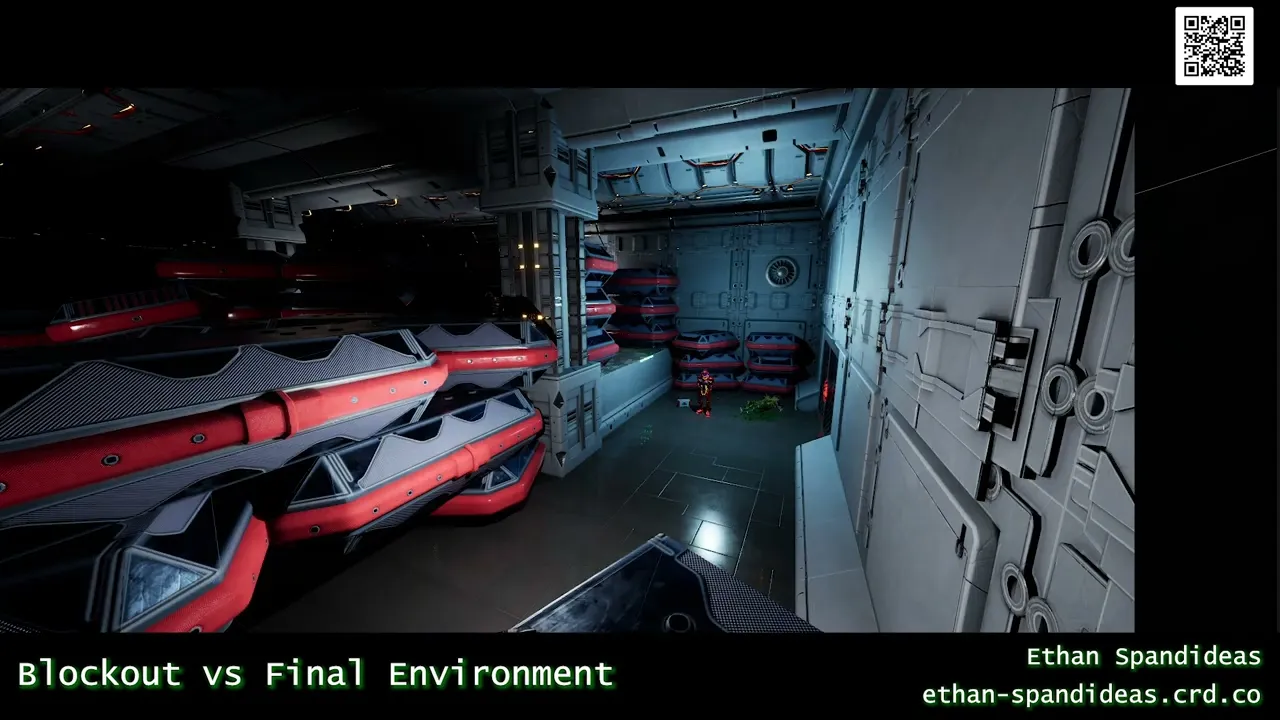
In Unreal, I allowed the level to evolve in 3D, maintaining flexibility to adjust scale, flow, and the player’s perspective.I applied level design techniques to guide players intuitively, including leading lines in geometry, lighting cues to highlight points of interest, and angled environmental elements to influence movement.Iterating directly in the engine let me test and refine pacing, direction, and player experience in real time, ensuring the level was both playable and engaging.

Blockout Bird's-eye view

Blockout Run section (w/ Leading Lines)

Blockout Final sentry area


Iteration From Playtesting

Before
Players often missed the assault rifle, becoming distracted by upcoming enemies, which left them underpowered for the fight.
ㅤ
ㅤ

ㅤ
ㅤ

After
I extended the wall behind the body to block the view of upcoming enemies, ensuring the gun on the ground was the main point of interest. I also moved the gun next to the medkit, in case players picked up one but missed the other.

Before
This area starts with a single enemy, followed by two more rushing down the stairs once the player enters. The main issues were that players would eliminate the first enemy and then ignore cover, and that the explosive barrel was too well hidden to be useful.
ㅤ
ㅤ

ㅤ
ㅤ
ㅤ

After
I added a neutral, unarmed NPC that the initial enemy shoots at, and placed a post that blocks the player’s view of that enemy on entry, forcing them to move toward cover. To address the barrel issue, I removed the cover in front of it so that when the second enemy runs down from above, they stop next to the now-exposed barrel instead of safely behind cover.

Before
This area originally featured a spinning sentry that required the player to hide behind cover to avoid getting shot. It ended up being too difficult, since the player was never encouraged to use cover and movement together.
ㅤ

ㅤ
ㅤ

After
This area was fully reworked into a simpler turret that scans left to right. The player uses cover and waits for the turret to look away before opening the laser gate. This version better introduces movement skills alongside cover and timing.
Here's a showreel showing the whole process, and the before and after changes:
production
I used Monday to organise my goals and break them down into manageable tasks. This allowed me to track my progress, keep scope under control, and prioritise features that would lead to a complete and playable product. Having a clear visual overview of my goals and achievements also helped keep me motivated and focused throughout production.

Monday: Level Design Management

Key Takeaways
What went right?
I grew in confidence and overall knowledge of level design.
Player onboarding was clear, with mechanics introduced gradually rather than all at once.
Working in an industry-style 9–5 structure and collaborating with a mentor helped keep the project grounded and professional.
Iterating based on playtesting led to noticeable improvements in clarity and pacing.
Despite being a single demo level, the game feels like a complete and cohesive experience.
What went wrong?
Staying motivated toward the end of a solo project was a bit challenging, especially with preparing materials for a showcase too.
At times, passion caused the scope to quietly expand, which pushed the deadline back.
I am still building confidence with certain Unreal Engine techniques and workflows.
What have I learned?
A wide range of practical level design techniques through hands-on iteration.
Any change made should meaningfully improve the experience, not just change it for the sake of it.
Keeping scope realistic is essential when working within a fixed timeframe.
Paper prototyping and planning earlier would have saved time before committing ideas in Unreal.
Playing the game
Code_Break is available to download and play right now on itch.io!
ㅤ
July - August 2025

Platform: PC
Engine: Unity
Team Size: 5
Duration: 2 months
Palingenesis: The Gallery is a first-person horror puzzle experience, where players can swap between layers of a painting to alter their surroundings. This game demo was developed by a team of five people, made in just under two months for the showcase night 'GamesPond'.

1. context
As a group of recently-graduated uni friends consisting of two artists, two designers and one programmer, we decided on making a horror experience set in a strange and creepy setting. We also vowed to not have jump-scares, focusing on psychological horror instead.Additionally, we submitted a simple demo to GamesPond... and were accepted! This meant we had to start accelerating the project's production to make a showcase-ready build in 4 weeks.
2. My work
My task during pre-production was on game design. I helped design the system of swapping between layers of a painting, and deciding the mechanics each one would bring, and also creating the master Game Design Document.
Then during production, I got enthralled designing the 2D overview of the map using Adobe Illustrator and Miro.We wanted the players to feel enclosed in the gallery, but also wanted art pieces on display. I made sure to have rooms that were not too large for displaying art as the players explored, paired with tight corridors after each segment to add some tension.

(Tutorial) Room 1

(Tutorial) Room 2

Level 1


Mapping out the main points of the experience first also helped define it. We wanted a closing wall puzzle, elevator puzzle, and arrow puzzle for example, and then I designed around that list.The rooms utilised blood handprints and footprints to help guide the players, and show some environmental storytelling of past visitors barely making it through.I then began blocking-out the map on Unity using these designs as a stencil. I worked closely with our 3D modeller to make sure that this would fit into the scope.

Block-out near completion

Adding some template lighting


After finishing this, we were coming up on our GamesPond showcase. I helped our 3D modeller place in her assets, with lighting, and anywhere else I could. We also playtested, of course, finding lots of tweaks to improve for the day (mainly conveying tutorials better).
3. Conclusion
Palingenesis: The Gallery is an incredible project for me. I learned a lot of things, alongside an amazing team who are all super friendly and talented. My favourite constraint on this project was working with the horror setting. I discovered that I loved designing puzzles that had tension, my favourite being the closing walls with the keypad code.After GamesPond ended, we decided that we would continue to work on the game in our free time. This project is still running, and we hope to make it bigger than what it originally was!
Playing the game
The game isn't available publicly yet. However, you can follow our Instagram page to stay up to date with future updates on the project!
CREDITS
Chloe Fitchett - 3D Environment & Technical Artist
Emily Hardy - 2D Artist
Ethan Spandideas - Level & Game Designer
Lin Teo - Game Designer
Luca Palma - Programmer

February - November 2024

(With a Playable Demo Link Below!)
What's this game about?
Playing as a little slime named Goob, who's made out of paper, you must jump, fight and slingshot your way through the luscious and beautiful world of the slimes.However, enemies from the second dimension are invading, and seem to be slowly corrupting the world...

Multiple dimensions?!
That's right, in this game, you must master not only the 3D world but also the 2D paper world. These dimensional rifts can be found on walls, ceilings and floors throughout environments.
What's been made so far?
So far, we've made a short teaser demo that was shown at PAX 2024. In the future, we would like to implement a stronger narrative, interesting slime elemental powers, full-game level pacing, and smoother implemented mechanics in general.


My Roles on the Project:
For this folio presentation, I will only focus on my work in the second half of the project.
1. Level Design
2. Narrative Design
3. User-Experience
1. Level Design
In this late stage of development, my responsibility was to make sure the level flowed well, had an easy difficulty, and was fun to play. The draft levels I had created for this area initially were unfortunately too hard, so I had to redesign everything just over a month before PAX.The new level allows the player to walk around more instead of constantly jumping and makes room for enemies to exist. Pathways have also been used to guide the player towards the main goal, and side platforming is rewarded with collectibles.

Block-in

Final

Block-in

Final


I was also involved with assembling the level assets that our 3D modeller Chloe made. This included making sure the primary functionality experience was still there after adding all of the nice assets.

Block-in

Final


I was constantly playtesting playtesting playtesting, as I wanted to make sure that the level experience was friendly and intriguing. Sadly, I didn't have time to do it much as I was constantly creating new content that didn't even make it into PAX.

Block-in

Final

Block-in

Final


I additionally created two extra levels that did not make it into the final build. These included using ice and fire powers, but were not ready to show at PAX due to insufficient playtesting and 3D assets not being ready.
Ice Level Screenshots:


Fire Level Screenshots:


2. Narrative Design
Our game's narrative took a back seat due to my resources being focused on more important areas. However, two aspects were included in the final PAX build:
NPC Characters
The world is filled with little characters called 'Rock Slimes', being so because we didn't have a 3D animator to create slimes. They started as rocks with googly eyes for our placeholders, and the idea stuck with our team.Talking to each one gives quirky dialogue, and usually are accompanied with a prop that ties into their character, creating some fun for the player. My favourite is definitely the Builder Rock, as you can knock over his construction pipes, and he isn't impressed.

Magician Rock with flying carpet

Builder Rock, the player can knock over build

Paper tree objectives and Rock NPC stuck in ground


The Primary Objective
We didn't have much time to create a fully completable PAX demo, so to make a win condition I introduced the concept of glowing paper fruits found only on paper trees in the environment. When the player sees one, they know where to go, and can then focus on what's in front of them with a purpose.By collecting all five fruits, players can open a portal to complete the demo, providing a clear and engaging goal for them to aim for.

The player's goal

3. User-Experience
Our top priority that we struggled to master over this project was player guidance. We had often just thrown the player into levels that had designs that were confusing to understand, leading to a bad experience.So with the new level design and some tricks, we enhanced it extraordinarily using some elements including:
Text that simply explains the primary mechanics at the start of the level such as movement, combat and interact buttons.
Arrows made of slime appear in the 3D and 2D worlds, signifying the direction forward and usually that a slingshot should be used.
Collectibles being smartly placed to lead the player forward, and rewarding the player.

Writing to clearly explain to player

Floating Tutorials

Floating Tutorials

Floating Tutorials and Slime arrow

2D wall Guidance and Slime X on ground

Using Collectibles to guide player


So, What's to come?
The team hasn't confirmed if we want to continue anytime soon, but I would love to evolve these specific elements:
More puzzles: I would love to include more puzzle-based areas and things that make the player think more in-depth.
A stronger narrative: a story of a hero finding his place, and stopping a paper faction he thought was evil. filled with intriguing characters with motivations, arcs etc.
Boss fights: Interesting villains and menacing enemies to face.
And many more...
Will Goob embrace his slime roots to become the prophesied hero or be engulfed by his new paper power to become a bridge between worlds?We will have to wait to find out...
Playing the game
Simply press the download button on itch.io (and follow the install instructions):

Credits
Chloe Fitchett - Lead 3D Environment & Technical Artist
Emily Hardy - Lead 2D Artist, Animator, 2D VFX
Ethan Spandideas - Level & Game Designer, Narrative design, UX
Luca Palma - Lead Programmer
Richard Xu - Producer, Creative Director
Andre Villalon - Programmer
Other Programmers: Osal, Ethan H, Jared

September - November 2023

This game was created in the Swinburne subject 'Digital Game Prototyping Lab'.A versus game with a shifting power dynamic
Play as a fly or a scientist. The scientist can use items and lay traps to hinder and
eliminate the fly, while the fly tries to steal the scientist’s chemicals to grow in power to either defeat the scientist or escape.A complex environment allows traps and movement
The environment starts out in a two-story average Aussie house but then transitions underground to the scientist’s multi-levelled expansive underground facility.Different player mechanics and objectives in the same map/s
Each player’s role has its own progression but can be sabotaged by the other player. The Fly is quick and has to build power while the Scientist is slow and begins more powerful.The Scientist mechanics include walking, running, shooting, and protecting (crafting and placing traps cut due to time), while the Fly mechanics include crawling, flying, collecting, (venting and dodging cut due to time).The Swap
The fly gains a short burst of power, causing it to grow massive in size while destroying nearby traps as well as damaging the scientist if he is caught in the burst radius. It will activate when enough chemicals are collected to fill the power bar. The scientist isn’t modified during the ‘swap’, but he will have to adapt his strategy as the enhanced fly outclasses him.Power Progression
The scientist’s items and traps can be upgraded (by collecting materials and crafting
at the main area) while the fly’s movement and size can be upgraded (by collecting
chemicals).Audience and Platform:
This game appeals to people looking to have some fun competing against a friend in
a varied and expressive manner. The game will also have a science fiction and gothic feel in the sense of art style and narrative, which will appeal to people who like those genres of stories.Fans of party games, multiplayer games, puzzle games, first-person shooters and even real-time strategy in a sense, as the game is being designed around laying
traps for an opponent strategically, will all love our game. Aspects such as versus, player progression and outsmarting your opponent play into all these genres super well, and will provide a great balanced experience for both players to battle each other and see who wins.The game would be played on any platform that can deliver a satisfying split-screen experience, being primarily PC, Xbox, and PlayStation.
A few screenshots of the final game prototype:


My Roles:
For this game, I mainly focused on three main areas:
1. Level Design
2. User-Interface
3. Audio Design
1. Level Design
One of my main roles was designing the two levels the game would take place in. I started by designing the first level in Adobe Illustrator, and then blocking it in Unity to show the group how it would feel. After that, I went on to start adding materials to the map by importing free assets.

2D Level Design For Lab (Map) 1

Blocking-In Lab 1

Adding Materials Lab 1


I then went on to design map 2, and instead of making 3 maps, we decided to only have two because our scope was getting too large to finish on time. I then blocked it in like map 1, and then added materials and lighting to the map, and did the same in map 1.After that, the map was looking quite empty, so I started importing free props to populate the map and make it feel like a lab, adding unique flair to each room so the players can differentiate different parts of the map. That also meant creating a spinning collectible for each player to collect, which were a crafting model and a chemical model (image bottom right).

2D Level Design For Lab (Map) 2

Blocking-In Lab 2 and Adding Materials and Lighting

Adding Props

Adding Collectible Models for Fly & Scientist


We ended up having to cut map 2 out, which was pretty much complete but we couldn't implement the programming in time to keep it in. It was bigger and more sprawling than map 1, but due to time constraints we didn't have enough time to get it in.Images of maps 1 and 2:

The Assembly Room

White Maze Room

Synthetic Garden Room

Test Subject Room

Example of Air Vents

The Examination Room

The Elevator Area

The Cage Room

Scientist Hub Area

The Storage Hallway

The Office Room

Crossbow Shooting Range


2. User-Interface
After the artist, Cade, had designed the sketched out UI design mock-ups physically, it was my job to transform them into coloured digital designs on photoshop. I applied nice textures and differentiated the scientist and fly UI’s with bug shapes with wacky colours, and rounded shapes with metal to differentiate the sides. The scientist’s side of upgrades didn't make it into the game however.

Designing Digital Versions of Upgrades in Photoshop

Importing UI Elements into Unity, Connecting Sliders to Upgrade Bars


Here’s how the UI turned out. We ran out of time to implement the scientist’s facial expression changing, however all of the other bars and displays work, such as ammo, health, XP and the rampage metre.

Main Menu UI

Main Menu Options UI

Objectives Before Starting UI

Main In-game UI

Victory Screen UI

Defeat Screen UI


3. Audio Design
I also worked on all of the audio found in the game. This included when the fly is flying, the scientist is walking, and various other sound effects such as both of them attacking. I also kept record of all of the assets we were using on this Google Doc.

Example of placing audio into the scientist prefab

Example of script programming segment

Example of audio assets used in Unity


Finally, we also had a Trello board, where I kept the tasks I did updated.

Trello Board for the project

Playing the game:
If you would like to try out this game or any other games shown in my folio, feel free to email or contact me another way and I'll be happy to share the files through Google Drive.Please Note: This game's zip folder is 629MB to Download.
Credits
Earl Moragiannis - Lead Programmer, Gameplay Designer
Akaash Chand - Programmer, Animator
Ethan Spandideas - Designer, Writer, Level/Audio Designer, Programmer
Cade Haynes - Artist, Designer
Resources
All assets used are listed on this Google Doc.
Two
Sides
October 2023
Two Sides is a platformer game, made in 3 days for the Jomfy Jam 1 with the theme 'Coin Flip'!
About the Game:
Detective Conformation
October 2023
Notice: AI generation was used in generating the image backgrounds for this project. I do not condone using AI generation of any kind in projects, and only tried using it because it was a new unknown technology at the time (which isn't really an excuse).
Detective Conformation is a Twine choose your own adventure game, created in the Swinburne subject 'Writing for Interactive Narratives'.It was made using the SugarCube v2 extension, which allowed me to add images in the background and have a more robust coding system in place.
About the Game:
Detective Conformation is a sci-fi detective game about humanity, where the player must navigate through a murder investigation with an interesting plot twist.You get placed on the task of investigating a murder, and must complete it to get your detective degree to start your own firm. You get assigned a rebellious partner who is quite quirky, and investigate the sci-fi streets of the city Nova Vice.The game has Four endings, each determined by how much you acted as a lifeless robot, or a loving human. Some specific choices also impact what happens at the end, and the story is up to you how you play it.
A Few Screenshots of the Game:


Playing the game:
The full game is available to play on itch.io right now!Simply press the download button on itch.io (and follow the install instructions).
Resources
All images were achieved using https://app.leonardo.ai/ai-generations, some were modified by me using photoshop.
Survival Island
May - June 2023
Survival Island is a survival game where the player takes on the struggle of surviving on a cursed deserted island whilst also making hard narrative choices. This project was only allocated 5 weeks to be made as it was a 'Pervasive Game', but the final product represented a demo of the game. What the full game would have looked like is written further down.I was one of the two narrative designers and writers, and helped write the choices and consequences of the book gameplay. I also worked on the documentation side and other aspects that are shown further down. This game was designed for the Swinburne subject 'Pervasive Game Design'.A Few Screenshots of the Game:


A Short Trailer (showcasing the start of the demo and talking about what the full game would look like):
Mechanics:
Resource management – tracking food stores to maintain rations.
Gathering resources materials from resources on the island
Journal – The player journal is crucial to the players survival. The journal hosts all of the important information for the player: daily tasks, Inventory, Party status
Interactive narrative gameplay where choices matter and affect player progression
Companion – can help with completing tasks for the player.
About the Full Game:
"Survival Island" is a survival game where players start off aboard a sinking cruise ship. Their objective during this portion of the game is to gather essential supplies and escape the sinking ship. During this ‘phase’ of gameplay the player must contend with a timer, similar to "60 Seconds!", giving players a limited amount of time to collect necessary resources. After the player has gathered the resources they need, and returned to the lifeboat, they may choose to rescue other survivors.After the initial 60 seconds on the sinking cruise ship, players find themselves washed ashore on a mysterious and cursed island. Now, with the supplies they managed to gather from the ship, and the survivors they chose to rescue, they face a new challenge: surviving on this dreadful island.The supplies gathered from the ship will affect how the game plays out and present their own challenges depending on what you gather, allowing for a unique experience every playthrough.Gameplay on the island is separated between ‘Daytime’ and ‘Nighttime’. Throughout the day the player must complete tasks in order to manage their comfort bar and ensure they have enough resources for everyone they are with. The daytime gameplay will also be timed adding to the urgency of the tasks. The player can delegate certain tasks to their companions each day in order to help alleviate some of the time burden, however each companion can only perform one task a day. Your companions bring diverse skills and abilities to the group, so some will be ‘better’ at certain tasks than others; optimizing your delegation is the key to yielding maximum returns on resources.At night the players will work through nightly encounters, via an interactive narrative, that is centered around the curse on the island. Throughout the nightly encounters the players will have to deal with aggressive creatures, and eerie phenomena that test their resourcefulness. As the days pass, the island's curse intensifies, presenting new dangers and increasing the stakes. Players must adapt their strategies, scavenge for additional resources, and uncover the island's secrets to find a way off its accursed shores.
The Demo's Focus and Hopes for the Game:In the playable demo, players are able to go through the first few days upon arrival to the island. The player’s items and companions are chosen for them in order to offer the most all-encompassing playthrough possible. The daily tasks and nightly encounters are also scripted to showcase specific moments of gameplay.Ultimate we wanted to create a unique survival game that offered a bit of flare to the survival genre tropes by fusing concepts and mechanics from games we’ve enjoyed, like ’60 Seconds!’, ‘The Forest’, and even ‘Pathfinder’.Due to time and resource constraints, there were a few things we were unable able complete that could have included:
Future developments for this game would of course include a full story complete with more choices and resources as well as a full roster of potential companions. - This will include the initial timed portion of the game.
More intertwining decision in night-time encounters as well as, more intersection between what happens at night and what happens throughout the day.
Developed NPC systems to add a bit more life to companions.

Artwork Showcase (Done by Richard Xu)

Some of the things I worked on:
I worked primarily with the other narrative designer on the storyline. Each night the player would have to make a set of choices, so we used Google Docs and then Twine to plan out what the consequences of that would look like.Twine Branching Narratives for each choice Segment:

Final Tasks - Ordered by days

Night 1 and 2 - Branching choice trees

Night 3 - Branching choice tree

Sunset Day 4 - Branching choice tree


I also designed the ending screens, where depending on which of the four choices the player gets, the respective ending is shown on the daily newspaperThe Four Ending Newspapers:

Ending 1 of 4: Assisted Escape

Ending 2 of 4: Consumed

Ending 3 of 4: Escape

Ending 4 of 4: Dead


Playing the game:
If you would like to try out this game or any other games shown in my folio, feel free to email or contact me another way and I'll be happy to share the files through Google Drive.Please Note: This game's zip folder is 276MB to Download.
Credits
Gurjashan Randhawa - Lead Programmer and Designer
Duleen Weeraratne - Programmer and Designer
Wylon Yao - Designer
Richard Xu - Artist and Designer
Julian Willmore - Writer and Narrative Design
Ethan Spandideas - Writer and Narrative Design
Treasure Crusade
May - June 2023
Treasure Crusade is a two player versus game based on pong, where players fight from pirate ships by shooting each other's treasure and protecting their own. This game was designed for the Swinburne subject 'Introduction to Game Production'.Points are obtained by destroying enemy treasure and their ship, and first to 10 points wins. Use shields to defend yourself and your treasure. Your ship can be blown up if too many hits are taken so watch out! It will respawn after a few seconds however that leaves your treasure open and vulnerable.
My role was mainly programming the game in Unity with Ash. We implemented features such as dying, respawning, health, score as well as implementing the artwork and gif animations as sprite sheets.
Tools and Services Used:
Source Tree & Bit Bucket: For version control and sharing content with the group
Unity: To create the game
Trello: To help map out objectives and goals each group member needed to reach
Photoshop: For artwork such as the pixel art and main menu
Discord: For communication with the group
One Drive: To share game and subject documents
Screenshots of Source Tree (Bit Bucket) and Trello:

Source Tree (Bit Bucket)

Trello


Progress Screenshots of Development:

Week 1

Week 2

Week 3

Week 4

Week 5 - Final Week

Final Main Menu Design

Near End of Development Screenshot of Game


Screenshots of Final Game's Gameplay:


Playing the game:
If you would like to try out this game or any other games shown in my folio, feel free to email or contact me another way and I'll be happy to share the files through Google Drive.Please Note: This game's zip folder is 19MB to Download.
Credits
OverReact - Group Name
Ethan Spandideas - Programming and Design
Ashley Carboon - Programming and Design
Ruoyang Ma - Artwork
Resources
2D Treasure Asset
Shooting MechanicSound Effects:
Confetti
Splash
Explosion
April 2023
Midnight Snack (Pervasive Game)
'Midnight Snack' is a game that prioritizes the hearing senses over visual, where a hungry player tries sneaking to the fridge in pitch-black darkness while avoiding making noise which could awake their family. The goal was to have audio as the main mechanic indicating to the player if they have taken the right or wrong path, and if too much is created the sleeping family will awake, making the player lose. We did however have some visual aspect, where lights activate when noises are made so that there is some perceivable direction for the player.The first design area I focused on was the sound design, which was particularly important as each sound that gets played in-game will guide the player in the right direction. Recordings were done originally and collected, with sound effects such as the vase breaking shocks the player, and snoring would highlight to the player to stay away from that area as a family member would awake from noise nearby.

The second area being the level design did not come out as strong as the sound design. We tweaked the design creating multiple drafts, however we wanted to design a house that gave player choice as to where to go but ended up being a little too complex for inexperienced players to handle. This led players to get lost easily. This could have been avoided in a full release by designing easier levels for starting the game off, and then progressively getting more complex, branching, and bigger.

Draft - Concept 1

Draft - Concept 2

Final Level Design (Decided on one level instead of two)


This was only a pervasive game however, so the final build was very rough, but it was more about the mechanics and experimentation of the game.Screenshots of the Final Game:


Playing the game:
If you would like to try out this game or any other games shown in my folio, feel free to email or contact me another way and I'll be happy to share the files through Google Drive.Please Note: This game's zip folder is 32MB to Download.
Credits
Programmer - Harry, Luca Palma
Designers - Ethan Spandideas, Jack Wu
References
All sounds sourced from freesound.org and myself
May 2023
Journeys (Pervasive Game)
Journeys sees the audience taking the form of the controller and has the intended goal of dwindling the player count until there is only a few players left to claim the title winners. To respond to the Outside the Circle prompt, we wanted players to make decisions in the real-life space of the room they played in instead of on a screen. It succeeded, with its biggest strength being the social aspect of players seeing other’s decisions and talking about reasoning with them.Each of our four writer created a short narrative in a different genre to illustrate how the Unity game could function over various storyline genres and with different experimental choice scenarios.My story was inside the genre of science fiction, and the unique scenarios worked quite well, such as players placing their hands on their head so they would remember an earlier choice they did and eliminating players in special ways such as based on clothing colour.Although these aspects were intertwined with chance, it was what the core of the game was designed as, like how sometimes in real life we cannot fight randomness. We did leave hints however in the writing, which could have been a deeper mechanic.
Screenshots of the Final Game:


Playing the game:
If you would like to try out this game or any other games shown in my folio, feel free to email or contact me another way and I'll be happy to share the files through Google Drive.Please Note: This game's zip folder is 47MB to Download.
Credits
Programmer - Luca
Writers - Jaren, Ethan, Lin, James
References
Music sourced from freesound.org
May 2023
Scurvy Turvy (Pervasive Game)
Scurvy Turvy sees the player take control of a pirate surgeon who performs on patients in an unsteady pirate ship. Barrels fly around and the player may face other obstacles, but your goal is to successfully cure your pirate patient of anything they are diagnosed with (e.g. scurvy).Here is the in-game synopsis:
Meet Dockland ‘Doc’ Tarr, previously the saltiest scourge of the seas and now a reformed sea surgeon aboard The Precarious Pearl. The ship is currently battling against ships full of money hungry Privateers. As the battle rages on, more and more sailors are in need of your (arguably questionable) skills.Doc will need to patch (or chop … mostly chop) up broken sailors and get them back out there to lose more limbs. Unfortunately for the Doc, who's probably already drunk, the sea is about as angry as the privateers and The Precarious Pearl is catching some big waves.Your objective is to perform your surgeries while the seas throw you and your patients all around the sick bay.The mechanics of the game include:
• Running around
• Moving barrels/environment
• Timing your chop perfectly, with the two cutting items as options
• Item mechanics listed above under ‘items’, with different uses - different cutting tools with one having high risk but high reward
• You can grab items but only one at a time, you have to be facing it, and they move around the ship with the barrels
• Harming the patient randomly will make you automatically lose the game
• The goal can be to either save as many pirates as you can in the time limit (infinite patients), or save one patient (or set number of patients) by the end of the time limit
• Every 15 seconds, a modifier affects the gameplay for a short amount of time, Lasting 5-10 seconds
Miscellaneous Ideas for if it was developed into a full game:
• Timer based
• A chance of privateers coming down to fight the doc as he’s doing surgery, so you have to use the sword to fight
• Repair the ship’s hull. Items such as wooden planks could block up holes to increase time limit
• Dialogue wheels. The doc must convince the pirates that they need the surgery, or after the surgery they can convince them to join the team. Could also be used to direct away enemies after you finish with the patients
• Items that help with certain modifiers
• Called up to fight. There’s a chance that the crew above needs help in some way, so you have to exit the hull to the main area of the ship and help in some way. Either fighting pirates, firing the cannons, helping steer or anything the pirate crew needs

Example image of in-game (without player)

Playing the game:
Unfortunately, this game is not able to be played anymore. It was the first pervasive game we made for the subject, so was very basic and did not have any time for bug fixing anyways.
Credits
Programmers - Aidan Grimmett, Duleen Weeraratne
Writers - Julian Willmore, Ethan Spandideas
Artist - Darcy Lane

October 2022
One Hell of a Performance Review (Tabletopia)
Our Group's Digital Board Game 'One Hell of a Performance Review' on Tabletopia. This was for the Swinburne subject 'Principles of Game Design'.
In our Group, I took on the role of designing the Tabletopia build of the game. This meant creating the game on the Tabletopia website, importing artwork done by the artist onto playing cards, and creating boards for the players.Below are the first drafts for the Player's Boards, the Main Playing Board and the Magnetic map for the Main Playing Board, which allow cards to snap into place correctly:

Draft - Player's Board

Draft - Main Playing Board

(Magnetic Map) Draft - Main Playing Board


After some playtesting, changes were made to both boards, such as labels for the Main Board's card slots, added magnetic map to the Player's board, and more card slots to play on for the Main Board.

Final - Player's Board

(Magnetic Map) Final - Player's Board
Final - Main Playing Board

(Magnetic Map) Final - Main Playing Board


But before showing the final Tabletopia build, this is an image of the first build:

This is the first Tabletopia Build, with no main board, missing decks and no player areas for their cards.
And here are the Final Tabletopia In-Game Images:

Final Setup

Player Boards (with Counters & Dice Provided)

Main Board (with Card Decks, Token Bags and Character Cards)

Untitled


Final Tabletopia Game Page (De-listed Currently):

Credits
Artist: Ivy Roberts
Project Manager: Cat Ater
Writer: Ally Finch
Tabletopia Engineer: Ethan Spandideas
Game Design: Kartik Punna